Sustainable Polymer Materials & Ecosystem Engineering 2026
To achieve true sustainability, industries must transition from a linear to a more advanced circular model. Please find below three in-depth aspects that will become standard in 2026.
1. Advanced Chemical Recycling
In contrast to mechanical recycling, which involves the cutting of polymer chains, reducing the quality of the final product, chemical recycling through depolymerization is poised to emerge as the predominant solution by 2026.
- Pyrolysis & Gasification Technology: This process involves the breakdown of mixed waste plastics back into their basic monomers (such as pyrolysis oil).
- The following are the technical advantages: The production process yields polymers that are indistinguishable from virgin plastic. This innovation enables the utilization of recycled polymers in medical and high-performance engineering applications that were previously unattainable using mechanically recycled plastics.
- Educational Point: Please discuss how Polyintec facilitates the transition to using depolymerized materials with high thermal stability.
2. Polymer Compatibility & Compatibilizer Technology
The primary issue in Sustainable Solutions arises from the attempt to blend recycled polymers with new materials. In such cases, the use of Compatibilizer is particularly advantageous.
- Molecular Function: Compatibilizers act as a “bridge” between polymer phases that naturally do not mix (e.g., PE and PP).
- Performance Improvement: With the appropriate additives, the impact of strength and elongation of sustainable polymers can be increased by up to 40% compared to those without binding agents.
- Deep Insight: Please direct your attention to the manner in which the selection of particular block copolymers or modified polymers can contribute to the reduction of brittleness in production batches that utilize recycled materials.
3. Digital Product Passport (DPP) & Traceability
By 2026, the concept of “sustainability” must be supported by data. The European Union and global markets have begun to require supply chain transparency.
- Blockchain in Polymers: Each batch of polymers now comes with a digital identity that records the percentage of recycled content, carbon footprint per kilogram, and the origin of raw materials.
- Life Cycle Assessment (LCA) Analysis: Educate readers about GWP (Global Warming Potential) metrics. Sustainable polymers are not just about “biodegradability,” but about how much energy is saved during the polymerization process compared to traditional petroleum extraction processes.
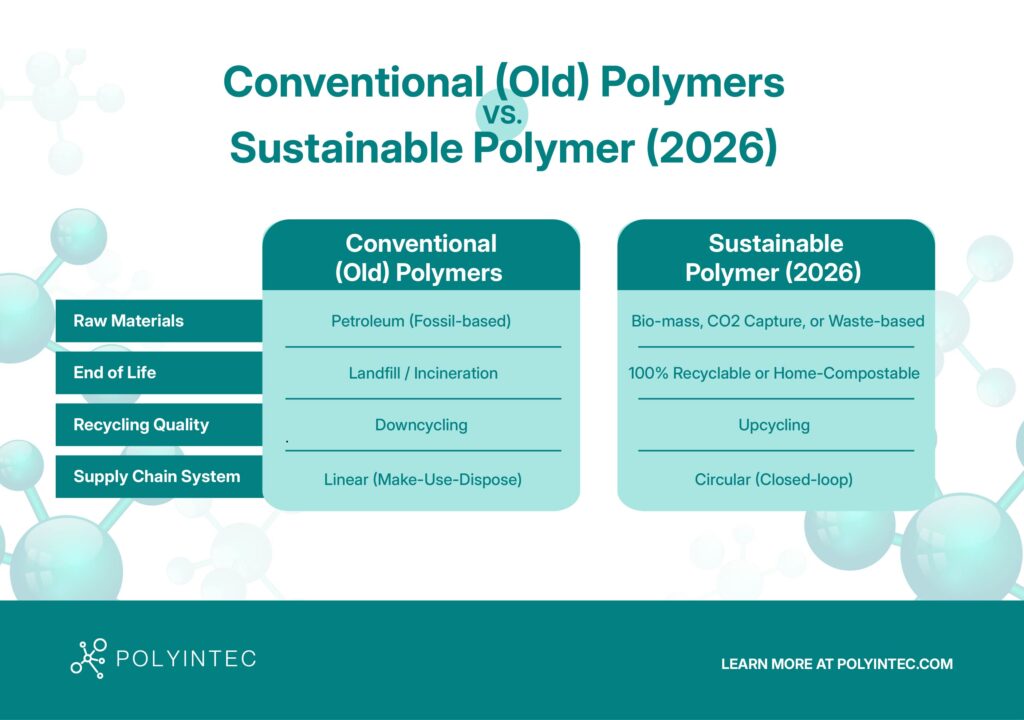
Technical Comparison Table: Past vs. Future (2026)
Why is this education important for Polyintec clients?
By 2026, companies that do not adopt this technology will be subject to high carbon taxes and find it difficult to penetrate export markets. Polyintec is not only a supplier, but also a technical consultant that helps your company optimize material formulas to remain sustainable without sacrificing profit margins.