How Additives Change the Performance of Engineering Plastics
Engineering plastics are selected for demanding applications where standard commodity plastics may not provide the required combination of strength, durability, temperature resistance, chemical resistance, or dimensional stability.
But the base polymer is only part of the equation.
Additives and fillers can significantly change how an engineering plastic performs, processes, and behaves in its final application. The right modification can improve mechanical strength, reduce weight, increase heat resistance, improve dimensional stability, enhance processing, or introduce properties that the base polymer cannot provide on its own.
For manufacturers, understanding these modifications is essential to selecting a material that performs reliably—not just in the laboratory, but throughout production and actual service conditions.
What Are Polymer Additives and Fillers?
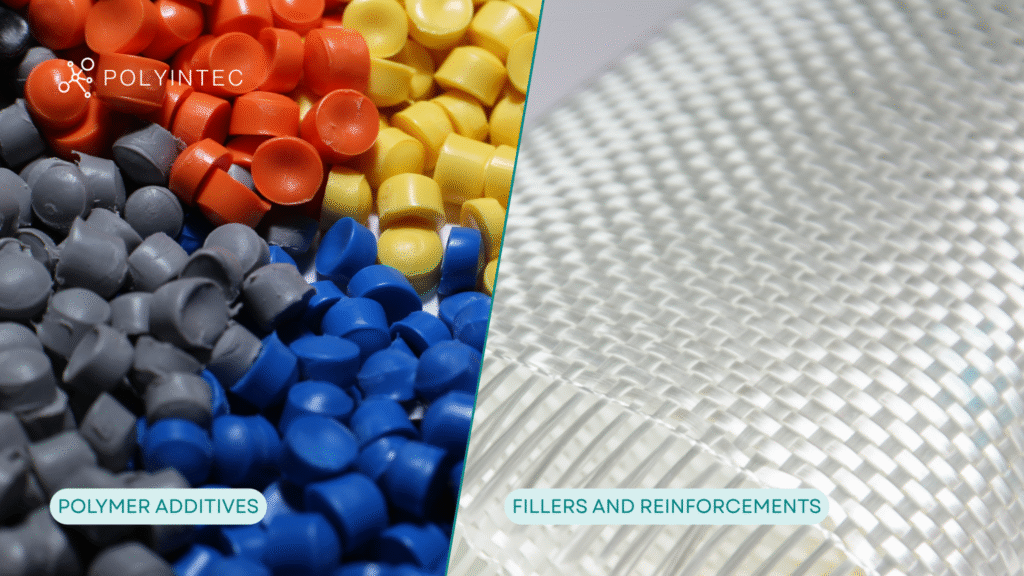
Polymer additives and fillers are materials incorporated into a polymer formulation to modify or enhance specific properties.
While the terms are sometimes used interchangeably, they generally serve different purposes.
Additives are typically used in relatively small quantities to improve specific characteristics such as:
- UV resistance
- Thermal stability
- Flame resistance
- Impact performance
- Processing behavior
- Color and appearance
- Surface properties
Fillers and reinforcements, on the other hand, are often added to increase stiffness, strength, dimensional stability, or other structural properties.
Common examples include:
- Glass fiber
- Mineral fillers
- Calcium carbonate
- Talc
- Carbon fiber
- Impact modifiers
- Flame retardants
- UV stabilizers
- Lubricants and processing aids
The result is a polymer material that is engineered around the requirements of a particular application rather than relying solely on the properties of the base resin.
Why Additives Matter in Engineering Plastics
Engineering plastics already offer strong performance compared with many commodity polymers. However, real-world applications often demand a very specific combination of properties.
For example, an automotive component may require high stiffness, low weight, dimensional stability, and resistance to elevated temperatures at the same time.
A standard polymer grade may not provide the ideal balance.
This is where modification becomes important.
By selecting the appropriate additives or reinforcement, manufacturers can fine-tune a polymer to better match the application’s operating requirements.
1. Improving Mechanical Strength and Stiffness
One of the most common reasons for modifying engineering plastics is to improve mechanical performance.
Glass fiber and carbon fiber, for example, can significantly increase stiffness and strength. These reinforced materials are often considered when components need to withstand higher mechanical loads while maintaining the advantages of plastic, including lower weight and design flexibility.
This can be particularly valuable in applications such as:
- Automotive components
- Industrial machinery
- Electrical housings
- Structural components
- Technical parts
However, higher reinforcement does not automatically mean better performance. The correct loading level and formulation must match the application’s mechanical and processing requirements.
2. Increasing Heat Resistance
Some applications expose plastic components to elevated temperatures for extended periods.
Additives and reinforcement can help improve a material’s ability to maintain its properties under these conditions.
For example, modified engineering polymers may be selected for components operating near engines, motors, electrical systems, or industrial equipment where thermal stability is critical.
The important consideration is not simply the maximum temperature a material can tolerate.
Manufacturers should also consider:
- Continuous operating temperature
- Exposure duration
- Mechanical load at elevated temperature
- Thermal cycling
- Dimensional stability
A material that survives a short-term temperature peak may not necessarily be suitable for continuous high-temperature service.
3. Enhancing Dimensional Stability
Dimensional stability is critical when components must maintain tight tolerances during manufacturing and service.
Temperature changes, moisture absorption, and mechanical stress can cause certain polymers to expand, contract, or deform.
Fillers and reinforcements can help reduce these effects and improve dimensional stability.
This is particularly important for:
- Precision components
- Electrical connectors
- Housings
- Gears
- Mechanical assemblies
- Components with tight dimensional tolerances
For manufacturers, improved dimensional stability can also contribute to more consistent production and fewer quality issues.
4. Improving Impact Resistance
Strength and stiffness are not the only mechanical properties that matter.
Some applications require plastics to absorb sudden impact without cracking or breaking.
Impact modifiers can be incorporated into certain polymer systems to improve toughness and impact performance.
This can be particularly useful in applications where components may experience:
- Drops
- Vibration
- Sudden loads
- Repeated mechanical stress
- Low-temperature impact
The challenge is finding the right balance.
Increasing impact resistance can sometimes affect stiffness, hardness, or other properties. Material selection therefore needs to consider the complete performance profile rather than optimizing one characteristic in isolation.
5. Increasing Chemical and Environmental Resistance
Engineering plastics are frequently used in environments where they are exposed to chemicals, moisture, UV radiation, or other environmental conditions.
Specific additives and material modifications can help improve resistance to environmental degradation.
For example, UV stabilizers can help protect certain polymers from degradation caused by prolonged ultraviolet exposure, while other additives can support performance under specific environmental conditions.
The correct solution depends on the actual exposure.
Manufacturers should evaluate factors such as:
- Chemical type and concentration
- Exposure temperature
- Exposure duration
- UV exposure
- Humidity
- Outdoor or indoor use
Choosing a material based only on its base polymer can overlook important environmental factors that affect long-term performance.
6. Improving Processing and Manufacturing Efficiency
Material performance is only one side of the equation.
A polymer also needs to process reliably.
Certain additives can improve processing characteristics such as flow, lubrication, release, or surface finish. This can help manufacturers achieve more consistent molding and production results.
Processing performance can influence:
- Cycle time
- Surface quality
- Mold filling
- Production consistency
- Scrap rates
- Overall manufacturing efficiency
This is why material selection should consider both how the polymer performs in the finished product and how it behaves during manufacturing.
The Importance of Choosing the Right Combination
There is no single additive or filler that makes a polymer better for every application.
Every modification involves trade-offs.
For example:
More reinforcement → potentially higher stiffness and strength, but potentially greater processing complexity.
Higher impact modification → improved toughness, but potentially reduced stiffness.
Higher filler content → potentially improved dimensional stability, but potentially different surface and processing characteristics.
This is why successful material selection starts with the application—not with a particular additive.
Manufacturers should first define the required performance and then identify the polymer formulation capable of delivering it.
How to Select the Right Modified Engineering Plastic
Before choosing a grade, manufacturers should consider five key areas:
1. Application Requirements
What will the component actually experience?
Consider mechanical loads, temperature, chemicals, moisture, UV exposure, and expected service life.
2. Required Material Properties
Identify which properties are critical.
Is the priority stiffness, impact resistance, heat resistance, dimensional stability, chemical resistance, or a combination?
3. Manufacturing Process
The material must also be compatible with the intended manufacturing process, whether injection molding, extrusion, or another method.
4. Cost and Commercial Requirements
The highest-performing material is not always the most commercially appropriate solution.
A good material choice balances performance, manufacturability, availability, and total cost.
5. Supply Reliability
A technically suitable material still needs to be consistently available for production.
Reliable sourcing is especially important when a specific grade or formulation becomes an essential part of an ongoing manufacturing program.
The Polyintec Approach to Polymer Solutions
At Polyintec, material selection goes beyond simply identifying a polymer grade.
We work with manufacturers to understand their application requirements, performance objectives, manufacturing needs, and sourcing considerations before identifying suitable polymer solutions.
Our approach combines polymer expertise with sourcing and supply support, helping manufacturers evaluate materials based on both technical and commercial requirements. This reflects Polyintec’s broader focus on tailored polymer solutions, technical assistance, global sourcing, and reliable supply. (Polyintec Mexico)
Whether you are evaluating reinforced engineering plastics, looking for a material alternative, or developing a new application, the right formulation can make a significant difference to product performance and manufacturing efficiency.
Make the Material Work for the Application
Additives and fillers are more than secondary ingredients. They are important tools for engineering polymer performance around real-world requirements.
The right combination can improve strength, stiffness, thermal performance, impact resistance, dimensional stability, processing, and long-term durability.
But the objective should not simply be to add more additives or choose the highest-performing formulation.
The goal is to find the right balance of properties for the application.
That requires understanding the material, the manufacturing process, and the conditions the final product will face.
At Polyintec, we help manufacturers evaluate these factors and identify polymer solutions aligned with their technical and commercial requirements.
Looking for the right engineering plastic for your application? Contact Polyintec to discuss your material requirements and explore suitable polymer solutions.