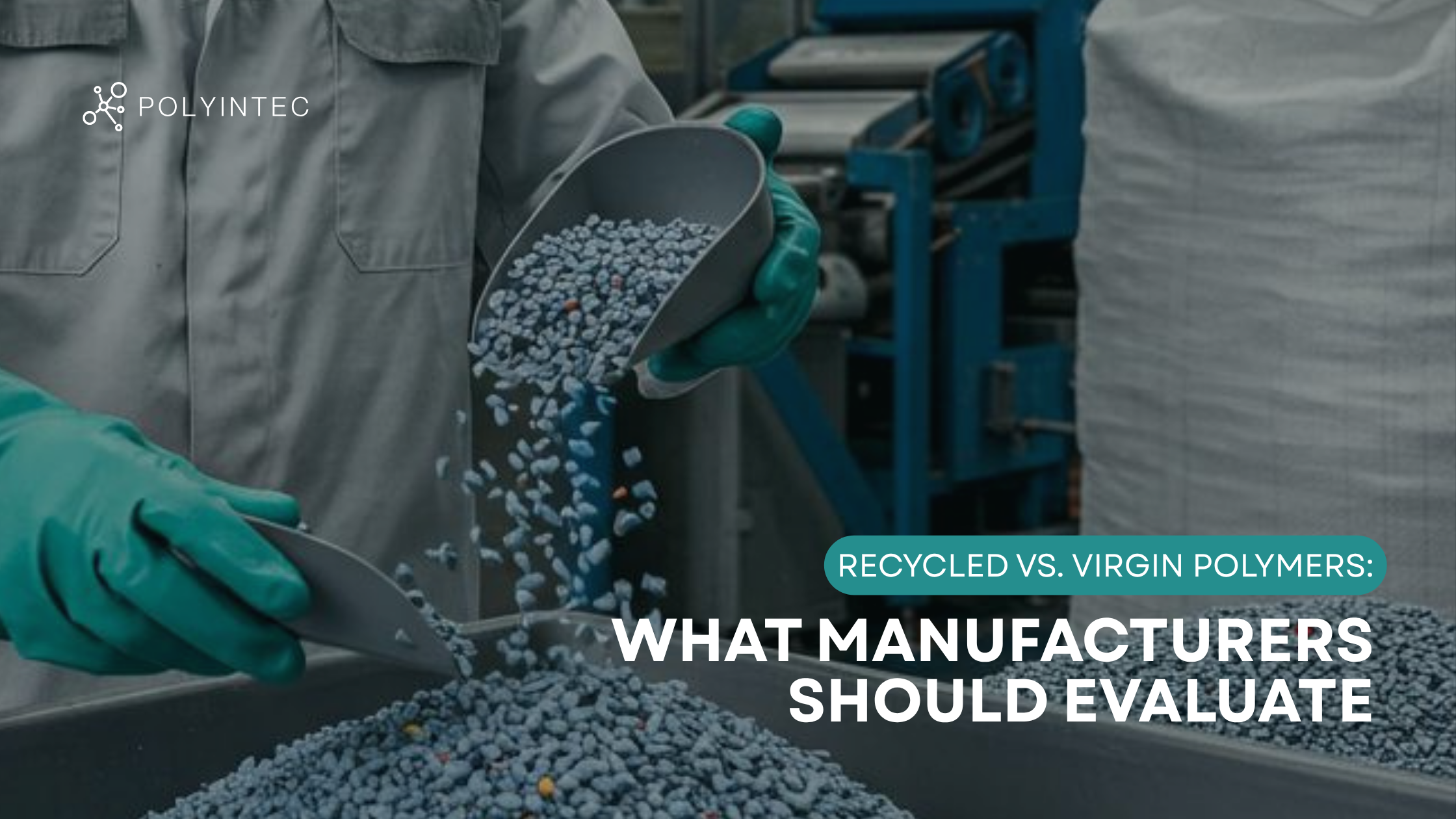
Recycled vs. Virgin Polymers: What Manufacturers Should Evaluate
Understanding material performance, consistency, processing requirements, and sustainability before choosing the right polymer for production.
As manufacturers face increasing pressure to improve sustainability while maintaining product quality, recycled polymers are becoming an important alternative to traditional virgin materials.
Virgin polymers have long been the preferred choice for many manufacturing applications because of their predictable properties, consistent quality, and established processing performance. However, advances in recycling technologies have made recycled polymers increasingly viable for a wider range of industrial applications.
But does choosing recycled polymers always make sense?
The answer depends on several factors, including the intended application, required mechanical properties, production conditions, material consistency, and overall cost.
For manufacturers, the decision should go beyond simply comparing recycled and virgin material prices. Understanding how each material performs under real production conditions is essential to making an informed sourcing decision.
1. Understanding the Difference Between Recycled and Virgin Polymers
Before evaluating material options, it is important to understand how recycled and virgin polymers differ.
Virgin polymers are produced from newly processed raw materials, typically through petrochemical processes. Their molecular structure and material properties are controlled during production, allowing manufacturers to obtain specific performance characteristics for different applications.
Recycled polymers, on the other hand, are recovered from plastic waste or previously used products and reprocessed into usable raw materials. Depending on their source, they can be classified into two main categories:
- Post-Industrial Recycled (PIR): Materials recovered from manufacturing processes, such as production scrap, rejected parts, or leftover materials.
- Post-Consumer Recycled (PCR): Materials recovered from products after they have been used by consumers and discarded.
The recycling process can introduce variations in molecular structure, material composition, and physical properties. These differences may affect how recycled polymers perform during manufacturing.
While virgin polymers generally offer greater consistency, recycled polymers can still meet the technical requirements of many applications when properly selected and evaluated.
2. Mechanical Properties and Product Performance
One of the most important considerations when comparing recycled and virgin polymers is their mechanical performance.
Manufacturers need to understand whether a material can withstand the physical demands of its intended application.
Key properties to evaluate include:
- Tensile strength: The material’s ability to withstand pulling forces before breaking.
- Impact resistance: Its ability to absorb sudden force or shock without cracking.
- Flexibility and elongation: How much the material can stretch or deform before failure.
- Stiffness: Its resistance to bending or deformation under an applied load.
During mechanical recycling, repeated exposure to heat and mechanical stress can cause polymer chain degradation. This may reduce molecular weight and affect properties such as tensile strength, impact resistance, and elongation.
However, the performance difference is not always the same across all polymer types. Some recycled materials can retain properties comparable to virgin grades, depending on their source, processing history, additives, and quality control.
What manufacturers should evaluate:
Compare technical datasheets and, where necessary, conduct laboratory testing to verify whether the recycled grade meets the mechanical specifications of the final product.
Material selection should always be based on actual performance requirements rather than assuming that all recycled polymers have inferior properties.
3. Material Consistency and Quality Control
Consistency is another critical factor in polymer selection.
Virgin polymers are generally manufactured under controlled conditions, making it easier to maintain consistent specifications between production batches.
Recycled polymers may have greater variability due to differences in:
- Original material sources.
- Polymer grades and compositions.
- Previous processing and usage history.
- Contamination from other plastics or foreign substances.
- Recycling and reprocessing conditions.
These variations can affect the final product’s appearance, strength, dimensional stability, and overall quality.
For manufacturers operating high-volume production lines, inconsistent raw materials can create additional challenges, including increased rejection rates, production adjustments, and quality control costs.
What manufacturers should evaluate:
Request material specifications, batch testing results, and quality assurance documentation from suppliers.
It is also important to assess whether the supplier can maintain consistent material quality and reliable availability across multiple production orders.
4. Processing Requirements and Manufacturing Compatibility
Even when two polymers have similar mechanical properties, they may behave differently during processing.
Recycled polymers can have different melt flow characteristics, thermal stability, and processing behavior compared with virgin grades.
These differences may influence manufacturing processes such as:
- Injection molding.
- Extrusion.
- Blow molding.
- Thermoforming.
For example, variations in melt flow rate (MFR) can affect how easily a polymer flows through processing equipment. This may influence filling behavior, cycle times, surface finish, and dimensional accuracy.
Manufacturers may also need to adjust processing temperatures, machine settings, or material formulations when introducing recycled content into an existing production line.
What manufacturers should evaluate:
Check the melt flow rate, recommended processing temperature, thermal stability, and compatibility with existing manufacturing equipment.
Conducting production trials before full-scale implementation can help identify potential processing issues and determine whether adjustments are necessary.
5. Cost Efficiency Beyond the Purchase Price
Recycled polymers are often considered a more cost-effective alternative to virgin materials. However, comparing suppliers based solely on price per kilogram may not provide an accurate picture of total production costs.
A lower material price does not necessarily translate into lower manufacturing costs.
Manufacturers should also consider:
- Material rejection and scrap rates.
- Additional testing and quality control requirements.
- Machine adjustments and processing efficiency.
- Production downtime.
- Material availability and supply stability.
- Potential reformulation or blending requirements.
For instance, a recycled polymer with a lower purchase price may require additional processing adjustments or generate higher rejection rates. These factors can reduce the expected cost savings.
Conversely, when recycled materials consistently meet the required specifications, they may offer an opportunity to reduce raw material expenses without compromising product quality.
What manufacturers should evaluate:
Consider the total cost of ownership (TCO), rather than focusing exclusively on the initial material price.
The most suitable polymer is the one that delivers the right balance of material cost, processing efficiency, product performance, and supply reliability.
6. Sustainability, Compliance, and Material Traceability
Sustainability is becoming an increasingly important consideration in material sourcing decisions.
Using recycled polymers can help reduce dependence on virgin fossil-based resources, support circular material flows, and potentially lower environmental impacts.
However, the environmental benefits depend on several factors, including the recycling method, energy consumption, transportation, material quality, and the percentage of recycled content used.
Manufacturers should also consider regulatory and application-specific requirements, particularly for products involving food contact, healthcare, automotive, or other applications with strict material safety standards.
Not every recycled polymer is automatically suitable for every application.
Material traceability is equally important. Manufacturers should understand where recycled materials originate, how they are processed, and whether the supplier can provide the necessary documentation to support quality and compliance requirements.
What manufacturers should evaluate:
Review recycled content documentation, material safety information, relevant certifications, and applicable industry regulations.
A reliable supplier should be able to provide sufficient information about material origin, composition, and quality assurance processes.
7. Should Manufacturers Choose Recycled or Virgin Polymers?
There is no universal answer. The right choice depends on the product’s technical requirements and production priorities.
In general, virgin polymers may be more suitable when applications require highly predictable material properties, strict performance specifications, or established processing conditions.
Recycled polymers can be a practical option when the material meets the required specifications and the application allows for acceptable variations in performance.
Some manufacturers may also consider blending recycled and virgin polymers to balance material performance, cost, and recycled content targets. However, blend ratios should be determined through technical evaluation and production trials rather than assumed to deliver a predictable result.
The key is to select materials based on their suitability for the intended application, not simply whether they are recycled or virgin.
Making Smarter Polymer Selection Decisions
Choosing between recycled and virgin polymers requires a careful evaluation of technical performance, material consistency, processing compatibility, cost efficiency, and sustainability objectives.
While virgin polymers offer predictable properties for demanding applications, recycled polymers continue to create opportunities for manufacturers looking to improve material efficiency and support more sustainable production practices.
Ultimately, the best material is not necessarily the newest or the most sustainable option. It is the material that meets the required specifications, performs reliably during production, and delivers long-term value.
Working with an experienced polymer supplier can help manufacturers identify suitable grades, evaluate material specifications, and make more informed sourcing decisions.
At Polyintec, we believe that effective material selection starts with understanding the application. By evaluating material requirements, performance expectations, and sourcing considerations, manufacturers can make better-informed polymer decisions for their production needs.
References:
- Comparison of Recycled Polymers with Their Virgin Counterparts (2026) — Mechanical, chemical, thermal, and environmental comparisons.
- OECD: Chemical Content Validation of Recycled Plastics (2026) — Chemical safety, traceability, and quality control.
- Appropriate Characterization of Post-Consumer Recyclates (2025) — Material characterization and performance variability.